
What is a solidarity economy and how will we make a just transition towards it? It is a question that the People’s Solidarity Hub (PSH) contends with alongside many other groups.
Earlier this summer, the campus got a visit from one of the premier organizations doing the work to answer the same question: the New Economy Coalition (NEC). They approach solidarity economy work from a multitude of angles that include direct redistribution, education & training, culture & narrative work, and member gathering & governance.
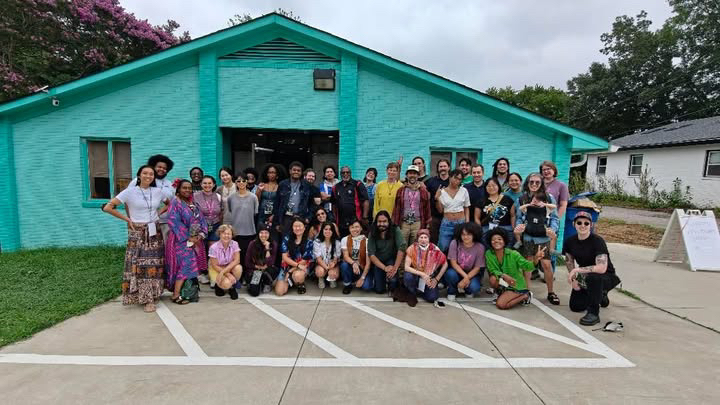
Visitors from New Economy Coalition gather outside of PSH’s Sassaras Center
Credit: Jae S.
With nearly four dozen NEC members in tow, the PSH team led a tour of the Sassafras Center, Yarrow House, and incoming Paw Paw Gardens and Fig Pavillion spaces on campus. Members of the PSH and Southern Vision Alliance (SVA) team were invited into conversation with the NEC members about how PSH works and the challenges it faces. At the center of many of these questions was the inquiry: how does PSH’s Solidarity Scale work and what learnings is the PSH team gathering from its experimentation with this model?
The PSH took this time to offer an explanation of the Solidarity Scale, describing it as an invitation for people to enter an experimental economic model that centers trust, solidarity, and communal responsibility rather than profit. It is an opportunity for communities to enter into a dynamic where they are given the autonomy to self-assess their ability to access a resource, based on their position in our current hierarchical economic system.
The majority of PSH users exist as a part of an exploited working class where the compensation for their labor does not cover the cost of their basic expenses, let alone resources for powerbuilding, healing, or play. As a result, nearly 75% of PSH users are only able to pay on the lowest end of the sliding scale ($10/hour) for their use of one of the PSH spaces. With wages stagnating, unemployment skyrocketing, and the cost of living rapidly increasing, the PSH and SVA team knows this scale is not likely to tilt the other way soon.
So how does the PSH and SVA team make it all work?
With the solidarity sliding scale, privileged community members are implored to take more responsibility to balance out the burdens that poverty and exploitation places on the majority of our current society’s workers. By offering more on the Solidarity Scale, people are investing in a model that ensures all community members can access one of the most critical resources needed to build power, community, and nervous systems that can withstand the transition into a new system: a physical hub where organizers can bring people together towards these ends.
The Solidarity Scale is built around a belief that our community has shared values of solidarity, equity, reparations, and justice. Because of these shared values, members of the more privileged classes have an opportunity to close the gaps created by capitalist exploitation. It is an invisible exchange of trust, faith, and mutual aid where the people giving and receiving are in relationship with each other oftentimes without meeting each other.
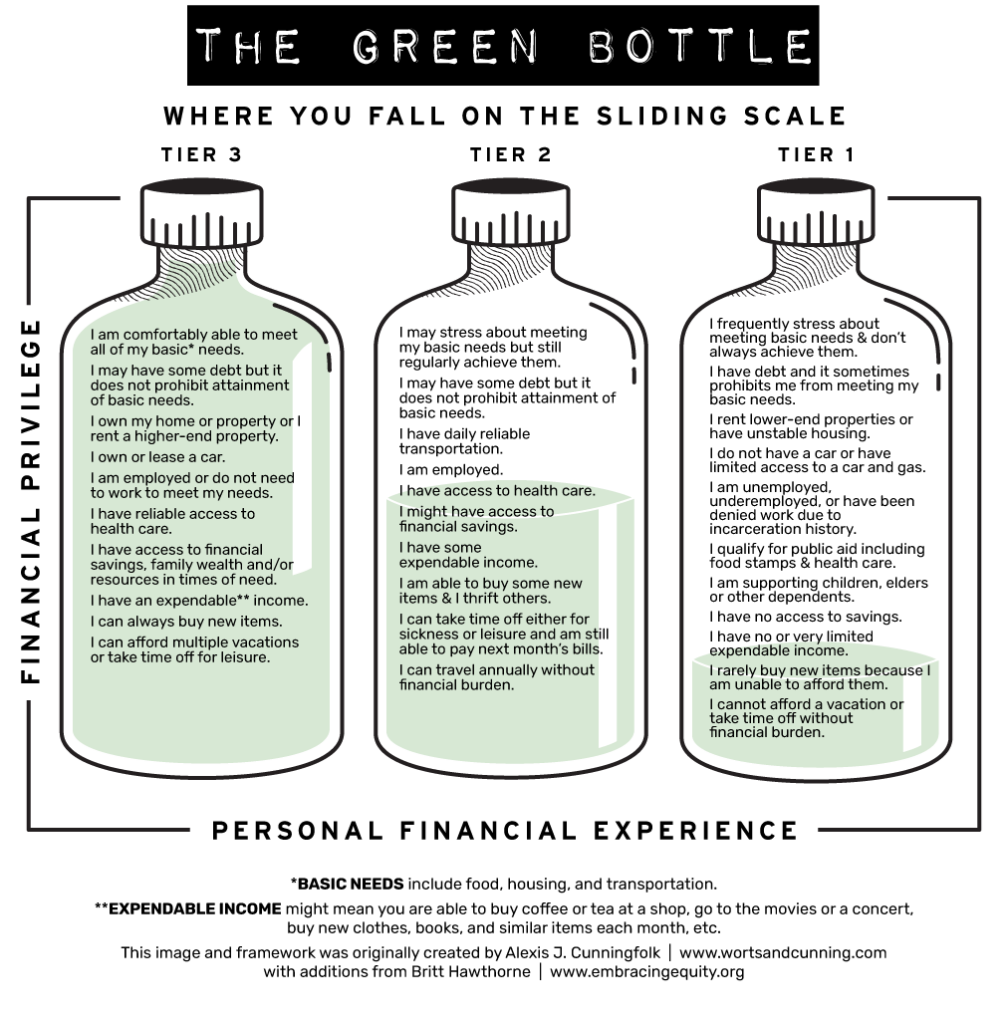
A graphic explaining the sliding scale model, conceptualized by Alexis J. Cunningfolk with additions from Britt Hawthorne
During the Q&A time, the New Economy Coalition members and PSH team were able to banter about the pros and cons of the Solidarity Scale model, as everyone tried to answer the question of what kind of economy will emerge after the collapse of our current system of extraction. After the Q&A, NEC members heard from local Durham organizers and workers whose work ranged from union organizing to cultural world building. During lunch time and intermittent breaks throughout the day, relationships were built that will hopefully become foundational to new experiments and projects in coming years.
The NEC visit was a beautiful opportunity for connection and exchange where people from across the U.S. were able to explore, imagine, and contemplate the challenges and wins that solidarity economy work will bring now and in the future.